Showing posts with label living things plant. Show all posts

Sunday, April 24, 2011

Rethinking Arbor Day

For the school child, Arbor Day is one of the unquestioned goodies of childhood indoctrination, like Washington’s or Lincoln’s Birthdays, a day to be happily and unequivocally celebrated by the planting of trees. But as the actual presidential birthdays have succumbed to our busy and efficient world of Monday holidays, perhaps it is also time to look at what Arbor Day is really about, how we came to celebrate it at all, and whether it is still a fitting holiday for today’s world.

In fact, our relationship with trees is ancient, vital, and undoubtedly eternal. It stems from primordial memories of our ancestors seeking cover and protection when threatened. Researchers have suggested that in the savannas of our species’ youth, certain trees and small woods offered refuge from the large cats and hyenas that were predators on early humans. Today, we are still attracted to such pastoral situations—open areas with good visibility, yes, but not unrelieved openness. Think of 18th century landscape paintings. It is not trees in deep woods that attract us, but smaller stands of isolated trees nestled in verdant meadows. Deep woods, in fact, add to our sense of danger and foreboding.

When J. Sterling Morton and his wife arrived in Nebraska from Detroit, unrelieved openness was pretty much what they found. The vast plains were a surprise to pioneers who had just spent several generations clearing their way through the dense forests of eastern North America. The few cottonwoods along the riverbanks were quickly depleted by a society focused on obtaining shelter and fuel, and settlers soon learned what it meant to live without trees.

From his platform as editor of Nebraska’s first newspaper, Morton promoted the planting of trees. On the first Arbor Day, celebrated on April 10, 1872, an estimated one million trees were planted. In 1885, when Arbor Day was made a legal holiday in Nebraska, April 22nd was set as the date for its observance. In his speech to a packed opera house, including 1,000 schoolchildren who had triumphantly paraded through town after their requisite tree-planting, he said

“...in picturing the heaven we long for, man’s brain has always drawn largely for its imagery from man’s vegetable co-tenants of the globe. This being man’s concept of human happiness, let us endeavor then ... to so embellish the world with plant life, trees, flowers and foliage, as to make our earth homes approximate to those which the prophets, poets and seers of all ages have portrayed as the Home in Heaven.”

Morton sought, especially, for his fellow citizens to help repair the denudation they had themselves created, as the “fifty-five millions of Americans consume daily for their varied uses 25,000 acres of forest.” (Today our number is 311 millions, and that effect has multiplied. We were only 270 million when I first wrote this article.) “We ought to bequeath to posterity as many forests and orchards as we have exhausted and consumed,” he added. Who could argue?

Here in this country, we settlers have always planted trees. We want to be in the company of trees. Growing up in rural New York state, whose original forests were decimated, we would travel the back lanes looking for old homesteads or graveyards, always spotting them by the characteristic pattern of artificially planted trees: A few Norway spruces, standing out darkly against the regrown deciduous forests native to the area; or looking closer, perhaps an old orchard, a few lilac bushes. In Wyoming, a similar pattern prevailed, with homesteads outlined by regimented windbreaks of Russian-olive. We plant trees, it seems, but we often plant exotics that instantly mark the landscape as man-made.

If you compare the way Denver looks today to historical photos, you know that things have changed significantly. And Russian-olive, once distributed intentionally for erosion control and “wildlife habitat,” is now outgrowing native cottonwoods and destroying wildlife habitat to such an extent that many declare it a noxious weed subject to eradication. This Arbor Day, as in most celebrations past, many of the trees to be planted will be exotic or ornamental introductions, especially those offered “free” by banks and others who haven’t thought through what they’re doing. Be wary. There are alternatives to remaking our landscape—we could plant more natives for example, if we must plant trees. Or we could learn to live with the prairie landscape we have. Yet, as we approach the 140th anniversary of Arbor Day, the National Arbor Day Foundation tells us, “a visit to Nebraska today would never disclose that the state was once a treeless plain.”

“Most of Earth's terrestrial ecosystems are treeless, and planting trees degrades them.”

—from Don’t Worry, Plant a Tree, by Ted Williams, Audubon magazine, May 1991

In harboring qualms about Arbor Day, one feels like a Grinch or a Scrooge. How can we not love the idea of planting trees? There’s a right way and a wrong way, a right place and, in the case of large parts of Colorado, “treeless plains.” We ought to think twice before planting, for there are many places where trees never lived and are still not needed today. Do you really want to be out digging holes and hauling water, when you could be relaxing and watching a field of native grasses waving in the spring breezes?

Not truly treeless, however, our prairies have their own arbors of cottonwoods, hackberries, chokecherries, even pines—all in appropriate places along streams or on rocky outcrops. In inappropriate places or inappropriate species, trees become a maintenance struggle, as most residents of the urban Front Range have discovered the hard way.

Eternal prairie and grass, with occasional groups of trees. Frémont prefers this to every other landscape. To me it is as if someone would prefer a book with blank pages to a good story.
—Charles Preuss, Exploring with Frémont, 1842

Although prairies do have their “good story” and their trees, they never support dense forests like those that were, ironically, destroyed by those who moved on to become born-again tree planters on the plains. The prairies had tenants of their own, tallgrasses and midgrasses, wildflowers most of us have never seen. The past tense is largely accurate, for most of the native prairie and many of its inhabitants are gone. Like the forests before, the deep-rooted true prairies that once thrived in our challenging environments were destroyed by the “sodbusters,” who then quickly learned the necessities of erosion control.

——
By Sally L. White, originally published in Colorado Gardener, April 1999


Sunday, December 26, 2010

A Harvest for the Holly Days

That holiday tradition of “decking the halls” is a long one still well practiced today. Seeing our homes and streets festooned with greenery, we might think little has changed from those nostalgic Victorian Christmases we emulate. Gathering decorative greens, however, is a rite best practiced in places where sustained harvests are possible. How well have familiar—and some not so familiar—holiday plants withstood the pressures of our seasonal festivities?

Taking the old songs seriously, we’d first observe a notable lack of “boughs of holly” in our local decorations. I’ve seen quite a few Christmases, and I’ve yet to see more than a small twig of actual holly at a time. In the milder climates of England and southern Europe, where it is native, holly (Ilex aquifolium) grows into a tree some 70 feet tall, and it is perhaps still feasible to harvest entire boughs for the mantelpiece. According to one study, regeneration of holly trees is not dependent on the seeds eaten by birds, which are deposited under trees in great numbers, because seedlings cannot survive the deep shade and high competition there.
Most successful young trees are found in well-lit patches where they are safe from grazing animals. Thus, cows may hold a key to holly’s long-term survival. Gardeners hold another: Many species of holly are also cultivated, even in milder parts of the U.S.

Ground pines, among my favorite plants, were once used to make wreaths—and may still be in lusher northern regions, such as Scandinavia. I think that most of us were born too late to see such abundance of this obscure plant in the U.S. You’ll find no red or white berries on this primitive plant—only spores. Other than decorative uses, those spores seem to be the most useful feature. They have been used for baby powder, to stop bleeding, and for flash powder for early photography. Thus the reproductive effort of these plants once literally went up in smoke.

Ground pines, also known as clubmosses, have had their day, and that day ended more than 300 million years ago. Thanks to the Denver Museum of Natural History, we can imagine what these ancient trees of the coal age may have looked like. These plants invented trees—and forests! Lepidodendron, the “scale-tree” as one example, was more than 100 feet tall, and grew in dense forests in the equatorial swamps then prevalent across North America and Europe. They, too, eventually went up in smoke; the vast coal deposits these prehistoric forests formed have kept entire countries warm for decades.

Now those ancient giants are gone, and only about 450 species of their lowly relatives survive. Most survivors belong to the genus Lycopodium, or wolf’s foot to Greek enthusiasts. We have few species of Lycopodium in Colorado; most abundant, though hardly common, is the unusual Lycopodium annotinum, stiff clubmoss, growing on the West Slope in small patches. This species occurs from Greenland to Alaska, where it is found in mature forests, especially those not disturbed by logging for many decades, and is occasionally eaten by moose. It is ranked S4, "apparently secure", in Colorado; very secure in much of Canada. Another species, L. alpinum, is "critically imperiled" in Colorado and Newfoundland, but rated apparently secure in the Yukon, British Columbia, and Alberta. (Photo by Franz Xaver from Wikipedia.org).

Are the remaining clubmosses on the way to extinction? If so, it may be that we have helped them down that road a bit. In moist forests of turn-of-the-century New England, ground pines were harvested in great volume for wreath material and other hall-decking. As a child in the northeast, I remember these wonderful plants but never found them in great abundance. About six inches tall at most, spreading outward in patches under the trees, these plants do resemble miniature pine trees. As with most “useless” plants of the forest floor, they are rarely discussed in forestry studies and rarely thrive in managed forests and tree plantations. In New York today, lycopods are protected on public lands, as they all, as a group, are considered to be declining and vulnerable to exploitation, in part because they regenerate very slowly after being harvested. Commercial collecting has made some species rare; the L. complanatum I remember is now considered "critically imperiled" in New York State, but L. obscurum remains secure there. [Explore the status of species of Lycopodium at NatureServe.org.]

Our wreaths and boughs today usually substitute easily gathered pine, spruce, and fir branches for these older plants. Some of us may be able to harvest boughs from our own backyards; most of us probably cannot. A few commercial collecting permits are offered in our nearby national forests; the Arapahoe-Roosevelt Forest this year [1996] sold commercial permits for about 8 tons of boughs at $50 per ton. (If you have a permit to cut a Christmas tree, you are allowed to pick up a few boughs for personal use.) Decorative boughs for wreaths and garlands are harvested from private lands in Colorado as well.

Some coniferous decorations offered for holiday sale here and elsewhere in the U.S. are imported from the Pacific Northwest, where trees are larger and grow more quickly. In the Wenatchee National Forest in Washington, more than 90,000 pounds of limbs and boughs were harvested in 1995, along with 500 bushels of cones and 2,500 pounds of other “foliage.” Perhaps some of this year’s harvest—regional or imported—will end up brightening your own front door.

——
by Sally L. White, originally published in Upbeat, December 1996, ©2010.


Saturday, November 13, 2010

Do Sleeping Plants Dream?

Disclaimer: It amazes me that this essay was written more than 14 years ago. Since then, science has indeed marched on, and an update on nastic movements is now posted over at Foothills Fancies.

My new prayer plant is an early riser. Although the sun is below the horizon and the room is dark, the sky is lightening, and she is already wide awake. How do I know? Well, some plants are dramatic in their daily movements, and her species is one of many that have attracted attention for centuries because they give the appearance of waking and sleeping each day. Pliny the Elder, a Roman scholar circa 75 A.D., remarked on the somnolent plants; much later Linnaeus devoted a famous essay, Somnus Plantarum, to the subject.

When I set out to write this essay, I wanted an appropriate subject to observe, and lo! not one of the 50+ houseplants in my current collection is this visibly hyperactive type. In my search I came first upon a prayer plant (Maranta leuconeura), although I might have found a dainty shamrock (Oxalis spp.), often available this time of year. If I were very lucky, I might even have encountered a sensitive Mimosa, a faddish plant that periodically disappears from the horticulture trade as each generation tires of touching them to watch the leaves collapse. (These days it may take more to amuse us, for I haven’t seen a Mimosa in years.)
Photo of Maranta leuconeura, awake!, by Kurt Stueber. From BioLib.de, Creative Commons, GNU Free Documentation License, accessed from Wikipedia.

But I shall have to get up early indeed if I expect to see this plant in action, her leaves unfolding from her nightly prayers to spread themselves in anticipation of the light. Trying again, I find that she is prepared even before the first hint of light appears to my eye, although she was sound asleep when I went to bed. In his study of plant movements, Charles Darwin observed dozens of plants that raise or lower their leaves in sleep. These plants don’t respond to light alone, he found, but to the cycles of light and dark, the difference between intense light and its absence. Plants need strong light and good moisture conditions to demonstrate sleep behavior. Plants that are stressed or disturbed, as his Maranta was by strong wind one night, remain sleepless for some time thereafter.

Typically thorough, Darwin lists sleeping species in 86 genera belonging to 26 distinct plant families, although the legumes have by far the most. Sleepers include species of lupines, milkvetches, sweet clovers, wild licorice, and many others whose relatives grow wild here in our foothills, as well as tamer ones like hibiscus and cotton, common garden beans and radishes, nasturtiums, four-o’clocks, and morning glories. Sleeping plants...it’s a charming concept that modern scientists tersely labeled nyctinasty (from Greek roots for night and pressing close), then mostly ignored.

Tracing the movements of individual leaves day after day, Darwin concluded that sleep movements are a modified form of the normal—though far less obvious—movements healthy leaves continuously make. How can a plant with neither muscles nor nerves move so quickly? You’ve probably noted that leaves are capable of abrupt position changes when they run low on water. We call it wilting. Most nastic movements are also based on hydraulic changes within the cells. By raising or lowering water pressure on opposite sides of the leaf stem, a leaf can move through angles of 90 degrees or more, and even turn on its axis. Some plants, such as my Maranta, are equipped with specialized joints that control their daily movements. These structures, called pulvini, occur where the leaf blade joins the petiole, functionally a bit like the wrist joint connecting your hand and forearm.

By forcing some leaves to stay “awake,” Darwin also tested whether plants are protected from cold nights by their cozy postures of sleep. It’s not the cold wind that’s the threat, he tells us, but radiation—a subject we tend to overlook. On clear nights, any exposed surfaces will lose heat directly to the open sky—to space, as it were. By folding up or down in sleep, leaves turn their narrowest edges to the sky, protecting their broad flat heat-losing surfaces. According to his experiments, leaves thus protected were less often damaged by frost. If sleeping offers such advantages, why don’t more kinds of plants—especially those in cold areas—sleep?

Well, they do, don’t they? Most of our local plants are deep in a season-long sleep, leaving only tropical houseplants to keep us company through the long deprivations of winter. While these companions keep us in touch with the spirit of plants, they also fill our shuttered houses with good green oxygen and remind us of spring. “Storms and winter weather,” some say, “bring plants and people close together.” We probably have a few storms yet to weather this winter, and can rely on our faithful houseplants to help us get through them.

Although we have an extensive leguminous flora, I’m embarrassed to admit I’ve never caught one of them asleep. So when spring does come, I plan to take some walks at dusk, just to see if I can spot the “jerky movements” Darwin speaks of, and to see how many native cousins of the greenhouse plants he studied also sleep. Darwin noted in his classic understated style, “It is troublesome to observe the movement of leaves in the middle of the night,” although he did so nonetheless. Can such inconveniences explain why the fascinating sleep of plants is so little studied now? In his later years, although he rarely left his home grounds—or sometimes even his study—his curiosity and patience yield us marvels to contemplate more than a century later.

——
by Sally L. White, originally published in Upbeat, March 1996, ©2010.


Tuesday, June 01, 2010

A Light in the Forest: Aspens and Fire

The morning after fire, burned soils are slowly cooling. Lodgepole pine seeds drift down from cones opened by the intense heat. Light breezes stir the layer of ash on the ground. Survivors—birds, mammals, and other forest life—are already seeking new homes. The forest is quieter today and smells strongly of fire. For us humans, fire is a terrifying and uniquely threatening experience—one we cannot always control or appreciate. We see only a charred landscape, and grieve. But while we continue grieving, nature simply begins again.

Already the shallow lateral roots of aspen are feeling the effects of auxin deprivation. The aboveground stems, now absent, no longer send their chemical message of living trees above, a message that has held potential new shoots at bay. Thousands of tiny buds, the primordia of aspen trees to come, are awakening to start the long process of recovery. Long, that is, by our standards. In the life of a forest, events will proceed quickly. In a year or two, there could be thirty young shoots for each mature stem that existed before the fire. Within 20 or 30 years, superficial evidence of fire disappears, leaving the aspen themselves as the primary clue.

In an aspen woodland, the life below ground is older than the forest we see, and it may well have seen fires before. In fact, aspen has an ancient relationship with fire, but it is an unusual one. With a lifespan comparable to ours (say 60 to 120 years), individual stems of aspen are short-lived as trees go. The forests they create thrive on the rebirth that fire provides. That is, until we came.

Today, aspen forests are as often rejuvenated by logging as by fire. Any method that removes the overstory trees without damaging the all-important root system is effective. In fact, researchers have found root density to be a key indicator of successful regeneration in aspen stands. Too few roots, and the aspens give way to grasses or conifers.

Of all the forest types adapted to fire, aspen is the least flammable and in many ways the most dependent on fire. Our other forests—of ponderosa pine, spruce and fir, or other conifers—burn more readily. In most seasons, aspen forests are either snow covered or too green to carry fire, and may even act as a firebreak, slowing or stopping fires that reach them. This trait is used to advantage by firefighters. In fall, however, when the lush understory has been killed by frost and the thick layer of aspen leaves has dried to a fine tinder, then aspen can burn and burn brightly.

Most fires in aspen woodlands occur in October under just such conditions. Such fires during the mid- to late-1800s gave us the aspen glories we drive to the mountains to enjoy today. We have so few deciduous trees: what would we do without the golden glow of October's aspen? Some years, extra hot and dry, give us Octobers to watch with caution, mindful of the long-standing relation between aspen and fire.

That dependence of aspen on fire has its own dynamic. Although they need fire, aspen forests are very vulnerable to it. Individual stems, with their thin bark, are girdled and killed by even moderate fires, but remember that the deeper life is underground. The parent root system must start over, each time, from scratch. Even a severe fire kills lateral roots only in the top two inches of soil. Suckers can sprout from laterals five to six inches deep if necessary.

If fires are too frequent, however, the roots will be exhausted from the efforts of renewal. If fires are too rare, occurring at intervals of more than a century or two, the aspen may grow old and die out beneath a dominant overstory of conifers, leaving no roots to replenish the site. Fire every 50 to 100 years is about right for continuous aspen, if that's the goal.

In comparison, ponderosa pine forests use a different strategy to achieve persistence through time. Frequent fires, every five to twenty years or so, thin the understory while individual trees live on, encased in their protective layers of bark. Fire delayed is made deadly. As we live with and in Colorado's forests, we are not required to choose whether or not we will have fire: we will. Our challenge is to decide whether we prefer fires to be frequent—or intense. Choose wisely, be careful, and enjoy the gentler side of aspen's October glow.

——
Copyright, S.L. White, 2010. Illustration copyright Jan Ratcliffe.
Originally published in Upbeat, October 1994.


Saturday, June 03, 2006

Spring Sap Rising

Groundhogs across the country have spoken, and everyone from the Farmer's Almanac to the National Weather Service seems to agree with them. An early spring. Not great news in a place that's seen too little of winter. Winter, as anyone who's been once around the sun in Colorado knows, brings us most of our urban water supply. And water, as we may be about to find out, is what brings us spring. We think spring is as inevitable as April 15th, but is it?

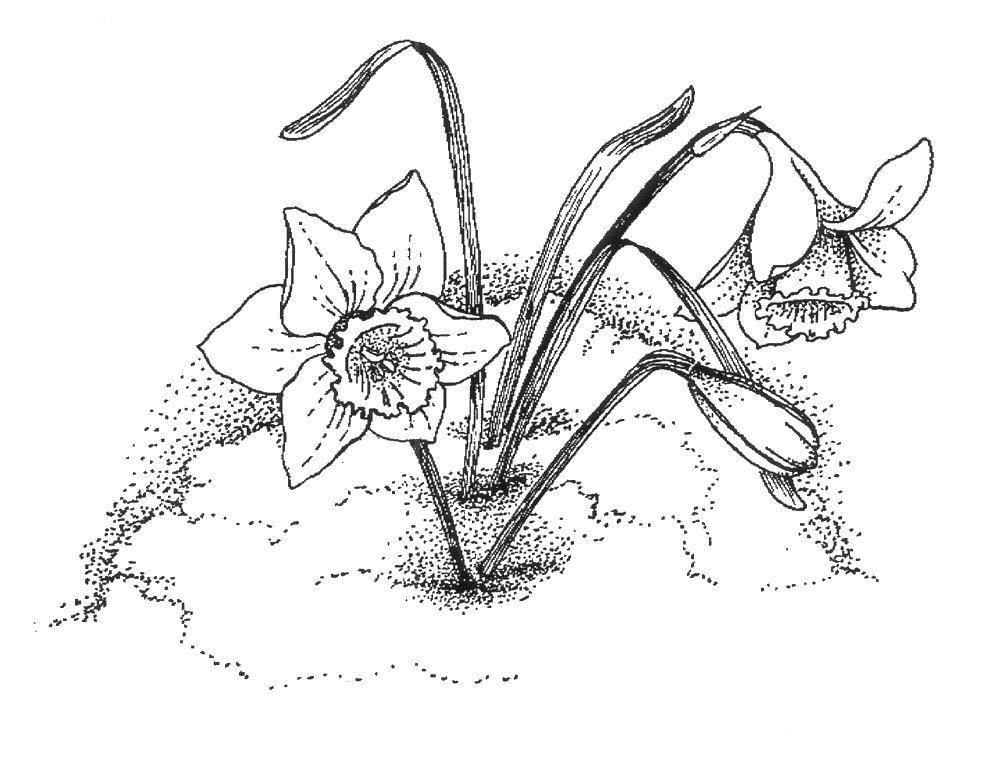
To anyone who's lived in places where the same snow remains on the ground from October until April, our winters are incomprehensible. This year, during most of the calendar winter, we've enjoyed weather that fits more properly in fall, even summer. Winter weather, with snow and cold and all, is frequently part of our calendar spring. Just when plants ought to, and indeed are trying desperately to, put out flowers and new leaves, they get killer frosts and heavy branch-breaker snows. Daffodil snows, I call them. We aren't the only ones tricked by Colorado's weather.

Is our weather getting trickier every year, or are we only imagining it? It's hard to take the long view and evaluate whether this is global warming we're seeing, or just a "normal" drought cycle. Okay, things are looking up today (I'm snowed in as I write this), but can a few heavy spring snowstorms make enough of a difference? Actually, this February storm alone has changed Denver Water's statistic for the Upper Colorado River Basin from 80% of normal to 95% within a few days. We need, however, to distinguish the mountain snowpack that quenches our thirst from the local precipitation that supports the life around us, just as we need to distinguish the calendar seasons—only an astronomical guideline—from what's going on in the real world.

Although only about a quarter of our moisture falls as snow, the large areas it falls on feed the streams that fill our reservoirs. March and April snows put down moisture that can soak deeply into soils. More than half our moisture, though, comes during the growing season—between May and September—and almost all of that is directly and immediately used by plants. Thus, the effect of dry periods—whether they disturb us or our local environments more—depends on when they strike. Last summer, which ranked among the five hottest and driest in a 123-year record, clearly disturbed plant life throughout our area, as moisture eluded them just when they needed it most.

The largest part of the structure of a tree is the water-carrying plumbing that brings us spring. This tissue we call wood is dead, but not dry as long as the tree lives. (The living parts of a tree are tiny fractions at either end—tips of roots, tips of stems—and a continuous paper-thin cylinder of living tissue that connects them.) The wood itself is made up of long, narrow dead cells, connected end-to-end like straws, through which water and nutrients are pushed and pulled up into the leaves and needles. The physics of water movement in a straw, or in a plant, requires that the water column be continuous from one end to the other, or from root to bud. Water pushes into roots from wet soil, but what happens when the soil is empty of water? No nourishment flows into roots; the upper ones wither away. From deeper layers, the fine roots continue to search for water; if there is none, they too die. As our warm, dry chinook winds suck more water from plants than can be replaced from dusty soils, the water column in the stem breaks, and spring begins to look less and less likely. Anyone who's carried a bouquet of wildflowers home to mom knows what happens when water is no longer being continuously forced or drawn into a stem.

We hardly ever think of sap, and when we do use the word, it's often to label something that isn't very impressive. Yet sap is responsible for creating glory for us each spring. Although sap is often pulled up the trunk of a tree or the stems of a shrub, especially by active leaves, it is also pushed. These pressures underground, of water moving from soil into root, from root into bud and leaf, make spring seem an undeniable force that simply must happen. Metaphors of rebirth, awakening, and hope flow into us, as into our religions, our poetry, and our visual arts, from the simple force of sap rising. It's in the spirit of those metaphors that we go looking for signs of spring, even in March. And often find them. I've seen green buds on the wax currants in mid-March, albeit icy ones. Some of our early flowers have even been known to appear in a February warm spell. I looked for Easter daisies in February, but no luck this time. Our temperatures welcomed them, but our dry soils wouldn't give them that underground push.

Fortunately, much of a Colorado "winter" occurs six weeks after the groundhogs have their say, often even after the arrival of calendar spring. I want to believe the almanac, which promises us a cold, wet March. Perhaps it will come in time to bring us a "sappy" spring after all.

Copyright, S.L. White, 2006. Illustration copyright Jan Ratcliffe.
Originally published in Upbeat, March 1995.

Latin Lessons: Classics in our Backyards

Once it was important, if one was to be considered truly educated, to study Latin, Greek, and other classical languages. Now that those days are long past, it’s good to know these “dead” languages still come alive in our backyards, meadows, and woodlands where they remain fresh and accessible to us through the living creatures that share our world.

Linnaeus established our present system of scientific nomenclature in the 1700s, and was the person who endowed all the plants and animals then known with their original names. There are two parts to a scientific name. The genus name, always capitalized, is followed by the species name, as in Homo sapiens, the name that designates all humans. Every living or extinct organism known is given a scientific name, and some become quite familiar, as have Philodendron, Geranium, Stegosaurus, Salmonella, and Giardia.

Most people seem wary, even phobic (from Greek, fear), of classical words when they’re applied to plants and animals. Yet we use these word roots constantly in our everyday lives, where most of us can distinguish our ophthalmologist (from Greek ophthalm, eye, and logos, study of) from our chiropractor (from Greek chiro-, hand, and Latin pract-, work) and can pronounce them both just fine. A simple shopping trip in your automobile (Greek auto-, self, with Latin mobil, movable) might include the local delicatessen (Latin, deli- pleasant, alluring), a stop to pick up cosmetics (Greek, cosmet-, well adorned) or medicine (Latin, medi-, heal), or a visit to the movie theater (do I need to do Arachnophobia?). There’s nothing (except spiders) to fear in these words.

We’ve spoken before of the men who are honored in the names of our familiar plants and animals. When an English, German, or Japanese surname is converted to Latin by the addition of a few vowels (each of which often becomes a whole syllable), the results range from tongue-twisting at best to downright unpronounceable. Yet many of the world’s critters will forever be burdened with awkward Latinized names honoring botanists, expedition leaders, patrons of science, or other celebrities of the day in which they made their first appearance in the world’s scientific publications. These Latinized twists fortunately render into English via easy possessives: Nuttall’s Cottontail (Sylvilagus nuttallii), Abert’s Squirrel (Sciurus abertii), Engelmann Spruce (Picea engelmannii), Gambel’s Oak (Quercus gambelii), Frémont’s Cottonwood (Populus frémontii), and Parry’s Primrose (Primula parryi) are good examples.

Very few women were admitted to this exclusive old boy’s club. Alice Eastwood (1854-1953), author of Colorado’s first flora, whose dedication to plants earned her a permanent place in botanical history, is commemorated in our rarest monkey-flower (Mimulus eastwoodiae). Although her long and illustrious career provides justification enough, she is also remembered for saving California’s important botanical specimens from the San Francisco earthquake in 1906.

If few real women are so honored, whence come all those seemingly female plants we keep hearing about: Lady’s Mantle, Lady’s Slipper, our own rare Ladies’ Tresses. One story is that many of these honor a Lady of considerable renown in the Christian world, the virgin Mary. After all, most of the scientists who named the world’s creatures for us were working in a predominantly Christian culture. But remember, they were also scholars immersed in a sophisticated intellectual community whose members would have considered classical references the stuff of everyday life and language. They had probably read Homer’s Odyssey in the original Greek.

Looking a little closer then, we learn that the Lady’s Slipper, our large woodland orchid, belonged to an older Lady still. The Latin name, Cypripedium, reveals its two roots. Cypri-, the Cypriot, refers here not just to any resident of Cyprus, but apparently to the famous lady who came ashore in a clam shell, none other than the lovely goddess Venus. Pedi- is a little more convoluted, but in this context must derive from the Latin root for “foot” (familiar to us in the word pedal), rather than the Greek roots for child (from which we derive pediatrics) and education (whence pedantic).

Our smaller woodland orchid, the fairy slipper (Calypso bulbosa), belongs to another lady of Greek myth. Calypso was the sea nymph who lured Odysseus from his quest to spend seven years with her on her island, much as these delicate flowers now lure passersby to linger awhile in the dappled shadows where they are found by the lucky or observant.

Few schools today offer Greek or Latin; fewer still require them. Thanks to conventions established by Linnaeus, however, every student of life sciences must become conversant with these languages, even if she must learn them in a somewhat backward fashion. Gradually, through constant exposure, they begin to seep in and even to make sense. Each of these names has a story to tell, and, taken piece by piece, they’re really not so hard. A little knowledge may be dangerous, but in the end learning a few Latin and Greek roots saves a lot of time spent in the dictionary—and makes it far easier to understand what your doctor is telling you!

Copyright, S.L. White, 2006. Illustration copyright Jan Ratcliffe.
Originally published in Upbeat, November 1996.

Thursday, June 01, 2006

Douglas-Fir: By Any Other Name


The tree we know today as Douglas-fir (Pseudotsuga menziesii) baffled botanists for decades. People have known it as yellow spruce, red spruce, red fir, Douglas spruce, and Oregon pine. It's not unusual for a plant to have many common names, but this one has tried on many botanical names as well. Botanists first called it Pinus taxifolia, the pine with yew-like leaves. Later, they tried squeezing it in with spruces, then firs. In 1867, 75 years after it was made known to western science, they finally gave up and created a new genus (Pseudotsuga) to house Douglas-fir and its oriental cousins. Pseudotsuga, meaning false hemlock, reflects its similarity to true hemlocks, or Tsuga, which, to compound the confusion, is the Japanese word for larch.

Our species is named for Archibald Menzies, Scottish naturalist with the Vancouver Expedition, who first collected it in 1792. These grand trees occur from British Columbia to the highlands of northern Mexico, although our Rocky Mountain version of Douglas-fir (the hyphen reminds us it's not a true fir) is sometimes considered to be a distinct variety, called glauca for its bluish color. A second American species, bigcone Douglas-fir (Pseudotsuga macrocarpa) occurs in southern California.

The accepted common name honors another Scotsman, David Douglas, pioneer explorer-botanist of the Pacific Coast, who collected the seeds of Douglas-fir and also discovered many other new conifers in California and the Pacific Northwest. He once wrote to Sir William Hooker, recipient of the many specimens he sent to England: "You will begin to think that I manufacture pines at my pleasure." New species were, in those days, more abundant than botanists.

Through all the confusion of nomenclature, the trees have, of course, not changed perceptibly—nor has their utility been compromised by botanical uncertainties. If this tree was tough to categorize, it was easy to appreciate. In the temperate rainforests where Douglas-fir was first "discovered," its size, abundance, and the quality of its wood were all that mattered, and few cared what you called it. When you hear "old-growth forest" on the evening news, this coastal Douglas-fir is the tree in question. It comprises almost 90% of those forests. From the Blue Ox to the Spotted Owl, Douglas-fir is part of our lore and landscape. And more. For a century and a half, Douglas-fir has literally formed the foundation of our history and development.

In Oregon and Washington, Douglas-firs may reach 300 feet in height and 15 in diameter. Who could resist such timber? No one did. Its contributions to western civilization have been both mundane and monumental: from the humble 2x4s that hold up our homes to the massive beams of the Mormon Tabernacle, from the railroad ties and telephone poles that knit the growing West together to new (in 1925) masts for the U.S.S. Constitution, Douglas-fir has served our needs. Its popularity was assured, in part, by the demise of virgin eastern white pine, which had provided the Constitution's original masts in 1798, but no longer grew tall enough to do so. That species had dominated the lumber market from the late 1700s until its virgin stands were logged beyond effective use a century later. (Eastern white pine still occupies its original range, but it has not yet returned to its original glory.) Logging firms from the east shipped their lumberjacks (and sometimes their entire operations, mill and all) west to the new frontiers of timber, to the great forests of Douglas-fir.

Here in the Rocky Mountains, our trees do not grow nearly as big or as quickly. They can reach diameters of three feet and heights of 130 feet at maturity, about half the height of large scale coastal Douglas-fir. Our trees are, by necessity, better able to withstand drought and less shade tolerant than those in the Northwest. Rocky Mountain trees are also valuable as timber, though less so than their coastal cousin. Douglas-fir makes up about 10 percent of Colorado's forest acreage, but only accounts for about 5 percent of the harvested wood. Not for lumber or legend do we think of Douglas-fir today, however. This month, thousands of these elegant trees will once again deck our holiday halls. If you head out to public forests to "cut-your-own," you're likely to come back with a Douglas-fir: the young trees often have the attractive symmetrical shape expected of Christmas trees.

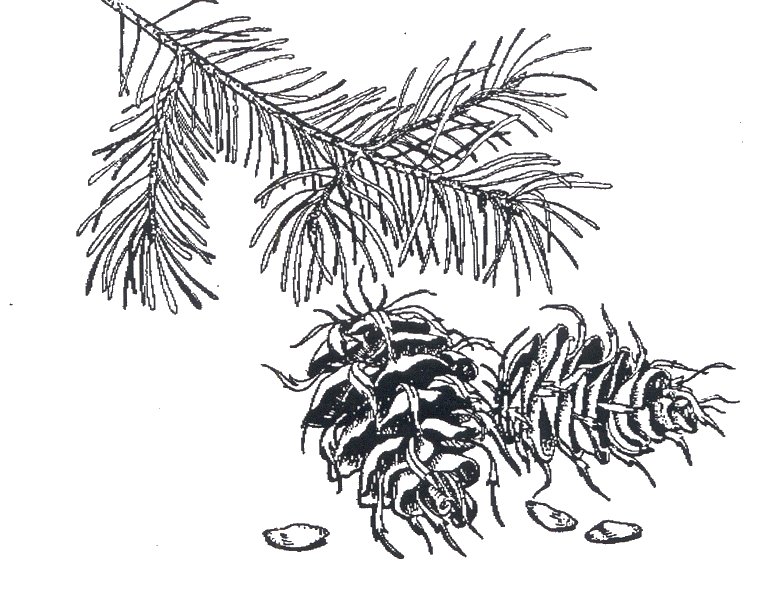
Never mind the differences—you'll recognize Douglas-fir wherever you find it. The 3-pronged bracts between the cone scales are unique to Pseudotsuga. In fact, it's often easiest to recognize Douglas-fir along the trail by the squirrel-cut cones you see on the ground; the leafy tops are often too tall to distinguish. You'll find its needles are flat but blunt, giving it a softer feel than spruces; its twigs are somewhat roughened—not as much as in spruces, but more than those of true firs. The graceful presence of Douglas-fir illuminates our woodlands from the foothills to the upper montane, but it rarely occurs in large, single-species stands. At its lower elevations, it often accompanies ponderosa pine, replacing it on the cooler north-facing slopes. In southern Colorado, it's likely to be found with white fir (Abies concolor).

In addition to its value to us humans, Douglas-fir provides many services to wildlife. Its branches provide cover and nesting sites; its seeds provide nourishment, but keep critters busy in the process. With 20 to 30 seeds per cone, a bushel of cones yields about half a pound of seeds. That's the entire production of an average tree in a good year. At that rate, by my clumsy calculation, it would take about 12 Douglas-fir trees to support one hungry squirrel through winter—if he can get all the seeds. (In real life, it probably takes even more trees. Squirrels might do better on ponderosa pine seeds, which have more calories, but they'll have to work harder to get them out of the tougher cones.) So how does a tree make sure some seeds survive to grow new trees? By tricking those pesky squirrels, and anyone else who's looking for lunch. Douglas-fir, and a number of other trees, have "learned" to do this by starving the squirrels (or forcing them to look for food elsewhere) during most years, then overwhelming them with a massive seed crop in an occasional good year. Because the squirrels can't take advantage of this sudden wealth, seeds have a better chance to escape and some will grow. Douglas-fir generally has one complete failure and two or more light crops between heavy, or "mast," years. As naturalist Sylvia Brockner tells us, this year is one of the good ones. We, and the squirrels, must be prepared for a few lean ones ahead.

Copyright S.L. White. Illustration copyright Jan Ratcliffe. Originally published in Upbeat, December 1994.

Monday, May 29, 2006

Everything's Rosy!


Here in Colorado's foothills and mountain slopes, our future is rosy. So is our present, and for some time, so has been our past. We are fortunate in that almost everywhere we look, we see roses. Although June is the traditional month for traditional roses, the native roses we enjoy here often appear in May. Many of them, however, masquerade under other names, some even under disguises so complete most of us never suspect their true identities. There are roses hiding, literally, in almost every one of the flowering shrubs we seek out for their color and beauty each spring.

Roses have long been the domesticated friends of humans, serving in a variety of capacities. Flower and fruit provide pleasure and food, fragrance and sustenance. Among familiar tame roses, we find apples, pears, peaches, apricots, cherries, strawberries, blackberries, raspberries: It's hard to make a fruit pie without involving one or another of Rose's cousins. If these fruits seem too diverse to be related, it's because the Rose Family, with 3,000 members worldwide and 69 species here, is large and a bit unwieldy. Botanists often divide it into three separate subfamilies: The apple subfamily, with its multi-seeded fruits, includes pears, quinces, and hawthorns; the peach subfamily includes the "stone" fruits, cherries, plums, and apricots; and the rose subfamily is a catch-all for the rest—strawberries, true roses, potentillas, raspberries, and so on. A close look at the flower reveals an underlying unity: Five petals and sepals—and many, many stamens—characterize roses.

If you think first of our wild pink rose, you're on the right track. It alone, of all our local roses, retains the Latin name Rosa, although its specific name is variously given as arkansana, woodsii, acicularis, depending on where you are. Most of us have difficulty separating these very similar species—for good reason, as Rosa itself is described as "taxonomically difficult." This genus alone has rosebuds, leaves, and "hips" nearly identical to those of our tame backyard roses, and is sought for rose hip jelly or tea. The Rose Family also includes many other dramatic and ubiquitous native shrubs. All are attractive enough, at least to me, to serve in domesticated situations, as well as in wild landscapes. Native roses—mountain mahogany, serviceberry, chokecherry, wild plum, potentilla—are readily available in the nursery trade, though you may have hunt for them. We're fortunate that local nurseries stock all of these and many other native shrubs. Several local roses also provide food, at least for those who trouble to collect fruit for chokecherry or wild plum jelly (or wine!) each fall. Chokecherries and plums are also greatly appreciated by coyotes and other local wildlife who enjoy their abundance in season. If you don't know how chokecherries got their name, try one!

Our other woody roses also have much to offer. The hawthorns (Crategus erythropoda and C. macracantha), with their lovely white flowers, glossy leaves, bright red fruits, and thorny red stems, are often found in foothills canyons. Feathery fruits adorn Apache plume (Fallugia paradoxa), a more-distant native transplanted from lower deserts. Rock spirea (Holodiscus dumosus) is a distinctive local shrub with a loose spike of minute rosy-pink flowers and soft, almost pleated leaves.

Two that may be less familiar but are well worth looking for are the Boulder raspberry (Rubus deliciosus) and mountain ninebark (Physocarpus monogynus). The Boulder raspberry, with conspicuous white flowers and less-than-inspiring fruits, seems to tolerate sun and shade, and thus is seen in a variety of habitats. Mountain ninebark has tiny white flowers in clusters—the plants look like spring snowdrifts in shady areas. It grows a little higher in elevation and blooms a little later than other roses. Both have an orangish, shredded bark that offers winter interest.

To avoid entrapment by the thousands of rose clichés western civilization has inherited, I'm being vigilant against a powerful temptation. Who could write about these plants that have so long and so gracefully served humankind without repeating the discoveries of centuries of Rose's admirers? I'll leave it to you to remember our rosy sayings, but I think you'll agree it's hard to name another plant family that's given us so much symbolism and legend down through the ages: from Eve's apple, to the briars that grew up to protect Sleeping Beauty's castle, to the symbol of love and loyalty still used by swains today. In song, in poetry, in our hearts, roses hold a special place. This year, remembering our natives, let the roses of Mother's Day say even more than they usually do.

And I will make thee beds of roses
And a thousand fragrant posies...

—Christopher Marlowe, 1599
Copyright S.L. White. Illustration copyright Jan Ratcliffe. Originally published in Upbeat, May 1995.